Barcelona landmarks
Photo: Hstoops · CC0

Landmarks

Barcelona's Most Iconic Landmarks

A deep, editorial guide to Barcelona's most iconic landmarks, from the Sagrada Família and Park Güell to the Picasso Museum, with history, what to see, and insider visiting tips.

Barcelona wears its imagination in stone, ceramic, and wrought iron.

This is the city that spilled beyond its medieval walls in the nineteenth century, laid down Ildefons Cerdà's revolutionary grid of chamfered blocks, and then handed that grid to a generation of Modernista architects who covered it with dragons, flowers, and undulating facades.

To walk its streets is to move between two cities at once: the dense, shadowed lanes of the Gothic Quarter, where Roman columns still stand inside medieval palaces, and the broad, light-filled avenues of the Eixample, where Antoni Gaudí and his contemporaries turned apartment buildings into fantasies.

What makes Barcelona's landmarks so compelling is that they are not isolated monuments. They gather along the Passeig de Gràcia and the Rambla, climb the green slopes of Montjuïc and Carmel, and press up against the Mediterranean that gives the city its light and its appetite.

The buildings converse across the boulevards, the public spaces invite you to linger over a vermut, and the museums hold collections that trace everything from Romanesque frescoes to the young Picasso.

The sea, warm and glittering, ties it all together and pulls the city outward to its beaches.

This guide gathers eleven landmarks that define Barcelona: the soaring unfinished basilica, the mosaic-clad parks and houses, the concert hall of colored glass, the ancient cathedral, and the world-class museums.

For each you will find what it is, why it matters, what to look for, and how to visit sensibly.

Read it front to back for an architectural narrative of the city, or skip to the places that call to you and build your own route through the Eixample, the old town, and up toward the hills.

Historic · Eixample · 1882

Basílica de la Sagrada Família

An unfinished cathedral of stone forests and molten spires that has been rising toward the sky for over a century.

The Sagrada Família is Antoni Gaudí's unfinished masterpiece and the most famous building in Barcelona, a vast basilica begun in 1882 that Gaudí worked on for more than four decades until his death in 1926.

He devoted the last years of his life entirely to it, and the project has continued ever since through wars, funding gaps, and the loss of his original plans, guided by his models and by generations of architects who inherited his vision.

Gaudí conceived the church as a sermon in stone, its three great facades devoted to the Nativity, the Passion, and the Glory of Christ, each in a strikingly different sculptural language.

The completed Nativity facade, carved in his lifetime, teems with naturalistic detail, while the later Passion facade is stark and angular.

Inside, the true revelation waits: a forest of branching columns that lean and split like trees, supporting vaults pierced with light, and stained glass that washes the nave in shifting pools of blue, green, gold, and red.

Recognized on the UNESCO World Heritage List and finally approaching completion, the basilica is engineered around towering central spires that will make it the tallest church in the world.

A visit is both a pilgrimage and an architecture lesson, revealing how Gaudí fused geometry, faith, and the forms of nature into something that still feels utterly unlike any other building on earth.

Even after a century of construction, cranes remain part of its unforgettable silhouette.

Visiting

The Sagrada Família is open daily, and timed tickets purchased well in advance online are essential, since same-day entry frequently sells out and lines are enormous. A basic ticket covers the interior; paying more adds an audio guide or a lift to one of the towers, which must be booked for a specific time slot. Go early in the day or late in the afternoon for the best light through the stained glass, and enter through the Nativity facade to follow the story in the order Gaudí intended. Allow at least ninety minutes.

Insider tip: Book a morning slot and sit on the eastern side of the nave: the sunrise light pours through the blue and green Nativity-side windows, saturating the columns with color in a way the afternoon crowds on the warm-toned side never quite see.

📍 View on Google Maps →

Park · Gràcia / Carmel · 1914

Park Güell

A hilltop garden of mosaic serpents, gingerbread pavilions, and a serpentine bench that overlooks the whole city and the sea.

Park Güell is Gaudí's exuberant public garden on the slopes of Carmel Hill, commissioned by his patron Eusebi Güell as an English-style garden city for the well-to-do.

The housing scheme failed to sell, and the site was eventually opened as a municipal park, leaving a landscape that feels like a fairy tale rendered in stone and broken tile.

The monumental core greets visitors with a pair of pavilions that look like gingerbread houses, a grand staircase guarded by the famous mosaic salamander known as el drac, and a hypostyle hall of tilting Doric columns meant to have served as a market.

Above it spreads the great terrace, edged by an undulating bench clad in trencadís, the shattered-ceramic mosaic technique Gaudí perfected, whose curves were reportedly shaped to fit the human body.

From here the view sweeps across Barcelona's rooftops to the Sagrada Família and the Mediterranean beyond.

Beyond the monumental zone, the park climbs through winding paths and leaning stone viaducts that Gaudí grew organically from the hillside, their columns resembling tree trunks and cascading rock.

Part of the UNESCO-listed group of Gaudí works, Park Güell is where his love of nature, color, and structural daring plays out at the scale of a landscape, making it one of the most joyful places in the city.

Visiting

The monumental zone of Park Güell requires a timed ticket booked in advance, with entry limited to protect the site, while the surrounding wooded areas remain free to wander. It sits uphill from the Gràcia neighborhood; the walk is steep, so many visitors take the metro and then the outdoor escalators, or a bus that climbs closer to the entrance. Come early in the morning to beat both the heat and the crowds around the mosaic bench, and wear comfortable shoes for the slopes. Allow around ninety minutes for the main areas.

Insider tip: Arrive for the first entry slot of the day and head straight up to the serpentine terrace before the tour groups arrive: for a short window you can photograph the mosaic bench and the city panorama almost empty, before the space fills for the rest of the day.

📍 View on Google Maps →

Historic · Eixample · 1906

Casa Batlló

A shimmering, bone-and-scale facade on the Passeig de Gràcia that seems to have been dreamed rather than designed.

Casa Batlló is Gaudí's radical remodeling of an existing apartment block on the Passeig de Gràcia, carried out for the textile industrialist Josep Batlló between 1904 and 1906.

Rather than demolish the building, Gaudí re-skinned and reshaped it, transforming a conventional facade into one of the most extraordinary surfaces in European architecture.

The front shimmers with a mosaic of glass and ceramic discs in blue, green, and gold that changes color with the light, while the balconies read like carnival masks or skulls and the columns twist like bones, earning the house the nickname Casa dels Ossos, the House of Bones.

The roof arches in scaled tiles like the back of a dragon, and a turret topped with a cross is often read as the lance of Saint George, Catalonia's patron, plunged into the beast, so the whole legend is coded into the building's skin.

Inside, Gaudí banished the straight line: doorways curve, ceilings swirl into whirlpools, and a light well tiled in graded blues mimics the depths of the sea.

Part of the UNESCO listing of Gaudí's works, Casa Batlló is one of the finest and most immersive ways to step inside the Modernista imagination without leaving the city's grandest shopping boulevard.

Visiting

Casa Batlló is open daily and operates entirely on timed, pre-booked tickets, which include an audiovisual guide and can be pricey, so buy online ahead to secure your slot and skip the queue. It stands on the Passeig de Gràcia within easy walking distance of Casa Milà, so the two Gaudí houses are often paired in a single afternoon. Early slots are calmer, and evening visits in summer sometimes include rooftop events. Plan for about an hour inside.

Insider tip: Look across the street before you go in: from the far pavement of the Passeig de Gràcia you can take in the whole rippling facade at once, and you will also catch the neighboring Casa Amatller and Casa Lleó Morera, the three contrasting jewels of the block nicknamed the Illa de la Discòrdia.

📍 View on Google Maps →

Historic · Eixample · 1912

Casa Milà (La Pedrera)

A wave of grey stone rising from the boulevard, crowned by a rooftop of warrior-like chimneys.

Casa Milà, universally known as La Pedrera, the Stone Quarry, is the last civil building Gaudí completed before dedicating himself wholly to the Sagrada Família.

Built between 1906 and 1912 for the businessman Pere Milà and his wife, its self-supporting stone facade ripples across the corner of the Passeig de Gràcia and Carrer de Provença like a cliff sculpted by the wind, with wrought-iron balconies twisting across it like seaweed.

The building was startlingly modern in its engineering: Gaudí used a structure of columns and beams so that no interior wall bears load, letting the floor plans flow freely, an idea that anticipated modern construction by decades.

The two interior courtyards funnel light and air down to the lower floors, and the apartments curve without a single straight partition. An exhibition space in the attic, framed by parabolic brick arches, explains his methods and models.

The crowning glory is the rooftop, an otherworldly terrace where the chimneys and ventilation towers rise like helmeted sentinels, some clad in trencadís and broken glass, arranged around the courtyards with the Sagrada Família framed in the distance.

Part of the UNESCO group of Gaudí works, La Pedrera is where his structural genius and his surreal imagination meet on a single rooftop.

Visiting

La Pedrera is open daily with timed tickets sold online, offering a daytime visit through the apartment, attic, and rooftop, as well as a popular evening experience with a light-and-sound show on the roof. Book ahead, as slots fill quickly and the rooftop can close in bad weather. It stands a few blocks up from Casa Batlló, so the two are easily combined. Aim for a clear day to enjoy the roof, and allow around an hour and a half.

Insider tip: If your budget allows, choose the evening rooftop show over a midday visit: seeing Gaudí's chimney warriors lit up against the night sky, with projections washing over the stone, is a far more atmospheric experience than the crowded daytime terrace.

📍 View on Google Maps →

Historic · Sant Pere / El Born · 1908

Palau de la Música Catalana

A concert hall of stained glass and blooming ceramic where music seems to pour down from an inverted glass sun.

The Palau de la Música Catalana is the dazzling concert hall designed by Lluís Domènech i Montaner, Gaudí's great Modernista contemporary, and built between 1905 and 1908 as the home of the Orfeó Català choral society.

Tucked into the narrow streets near El Born, it is an explosion of color and craft that celebrates both music and Catalan identity, and it stands on the UNESCO World Heritage List in its own right.

Every surface is alive with decoration: mosaic-clad columns, sculpted horses charging from the facade, and busts of composers presiding over the stage.

The main auditorium is the marvel, ringed by no solid walls but by soaring windows of stained glass, so that on a bright day the hall is lit almost entirely by natural light.

Overhead hangs the centerpiece, an inverted dome of stained glass in gold and blue that drops from the ceiling like a great sun or a hanging drop of the sky.

Behind the stage, a semicircle of muses rendered in mosaic and sculpture appears to step out of the wall, each playing a different instrument, blending flat and three-dimensional art in a way that feels magical in performance.

The Palau remains a working concert hall, so the ideal way to experience it is with music filling the room, though guided daytime tours reveal its wonders to those who cannot catch a concert.

Visiting

The Palau de la Música Catalana can be seen either on a guided or self-guided daytime tour, booked in advance for a timed slot, or, far better, by attending one of its regular concerts of classical music, choral works, flamenco, or jazz. It lies in the atmospheric lanes near El Born and the Gothic Quarter, best reached on foot. Daytime tours reward you with the stained glass at its brightest; a concert lets you hear how the hall was meant to be used. Tours run about an hour.

Insider tip: Check the concert calendar before you settle for a tour: an inexpensive short guitar or choral recital often costs little more than the daytime visit, and experiencing the inverted glass skylight glowing above you while music fills the hall is incomparably more moving than seeing it empty.

📍 View on Google Maps →

Historic · Barri Gòtic · 1420

Catedral de Barcelona

A soaring Gothic cathedral hiding a palm-shaded cloister where thirteen white geese have honked for centuries.

The Cathedral of Barcelona, formally the Cathedral of the Holy Cross and Saint Eulalia, is the Gothic heart of the Barri Gòtic, built mainly between 1298 and 1420 on the site of earlier Roman and Romanesque churches.

Its dramatic neo-Gothic main facade, bristling with pinnacles, was actually added in the late nineteenth and early twentieth centuries, completing a project the medieval builders had left plain.

Inside, the tall, dim nave draws the eye upward to ribbed vaults, while a richly carved choir sits at the center and a crypt beneath the altar holds the tomb of Saint Eulalia, the young co-patron of the city martyred, according to legend, in Roman times.

Chapels line the aisles, several preserving fine altarpieces and the coats of arms of the medieval guilds that funded them, a reminder of the merchant city that raised the church.

The cathedral's most beloved secret is its cloister, a green and tranquil courtyard shaded by palms and magnolias, with a central fountain and a flock of thirteen white geese, said to represent the age of Saint Eulalia at her death and kept there for centuries.

Climbing to the roof for views over the medieval rooftops, or simply resting in the cloister amid the honking geese, offers a moment of calm at the very core of the old city.

Visiting

The Cathedral of Barcelona is open daily, with a combined ticket that typically covers the interior, the choir, the rooftop terraces, and sometimes the small museum, while certain hours may be reserved for worship at no charge. It sits in the heart of the Gothic Quarter, an easy walk from the Rambla and Plaça de Sant Jaume. Visit in the morning for quieter aisles, and do not skip the rooftop, reached by a lift, for a rare high view over the tangled medieval streets. Allow about an hour.

Insider tip: Step into the cloister and find the geese before you tackle the nave: the palm-shaded courtyard is one of the most peaceful corners in the old city, and arriving before the tour groups lets you hear the fountain and the geese instead of a crowd.

📍 View on Google Maps →

Museum · El Born · 1963

Museu Picasso

A chain of medieval palaces holding the world's richest record of Picasso's formative early years.

The Museu Picasso, opened in 1963, occupies a run of five adjoining medieval stone palaces on the narrow Carrer Montcada in El Born, giving one of the world's great modern artists a home inside Gothic architecture.

The museum grew from a collection championed by Picasso's close friend and secretary Jaume Sabartés, and Picasso himself donated works, making Barcelona, where he spent his crucial formative years, the keeper of an unrivaled record of his youth.

Rather than the familiar late Cubist masterpieces, the collection's strength is the astonishing early work: precocious academic paintings made when he was a teenager, canvases from his Blue and Rose periods, and the environment of the city that shaped him.

Seeing his prodigious technical skill as a boy makes his later revolutions in art far more comprehensible, tracing the arc from a classically gifted student to the man who shattered the rules.

The undisputed highlight is Las Meninas, a series of fifty-eight paintings in which Picasso reinterpreted Velázquez's famous masterpiece again and again, dissecting and reimagining it in an extraordinary sustained act of homage and rebellion, kept together in dedicated rooms.

Wandering the vaulted halls and quiet courtyards of the palaces, with Picasso's work on the walls, is one of the most rewarding cultural experiences in the old city.

Visiting

The Museu Picasso is open most days, usually closing on Mondays, and timed tickets bought online are strongly advised, since the historic rooms are compact and can grow crowded. It stands on Carrer Montcada in El Born, a short walk from the Santa Maria del Mar basilica and the Picasso-favored streets of the old town. Certain evening hours and days offer free or reduced admission worth checking. Plan around ninety minutes, and follow the collection chronologically to appreciate his development.

Insider tip: Do not rush past the earliest rooms to reach the famous name: lingering over the teenage academic paintings first makes the Las Meninas series at the end land with far more force, because you understand just how completely Picasso was choosing to break the rules he had already mastered.

📍 View on Google Maps →

Historic · El Raval / La Rambla · 1840

Mercat de la Boqueria

A cavernous iron-and-glass market off the Rambla, piled with jamón, seafood, and rainbow towers of fruit.

The Mercat de Sant Josep de la Boqueria, always just La Boqueria, is Barcelona's most famous food market, opening off the Rambla behind a bright Modernista entrance arch and a grand roof of iron and glass.

A market has stood on or near this spot for centuries, evolving from an open-air gathering of traders outside the medieval city gate into the covered hall inaugurated in the mid-nineteenth century.

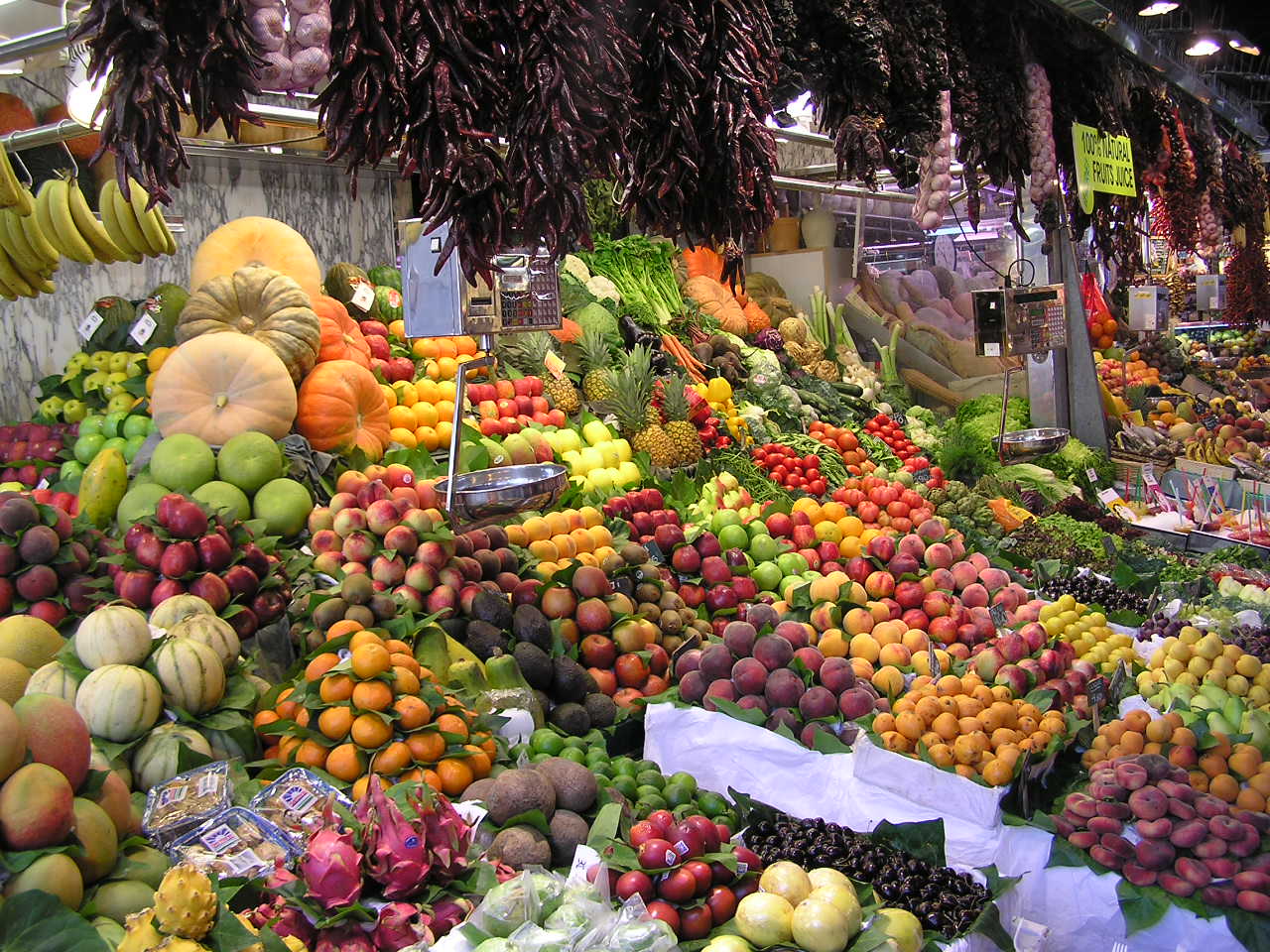
Under its high canopy spreads a feast for the senses: stalls of glistening Mediterranean fish and shellfish on ice, legs of cured Iberian ham hanging in rows, pyramids of oranges and figs, mounds of wild mushrooms in autumn, and cups of freshly pressed fruit juice near the entrance.

Family-run stands sell salt cod, olives, spices, and Catalan sausages, and the market remains a genuine shopping place for local cooks and the chefs of nearby restaurants, not merely a spectacle for visitors.

Woven among the produce are small counters and bars where you can perch on a stool and eat superbly, from a plate of grilled prawns or razor clams to a cortado at dawn beside the traders.

La Boqueria is where Barcelona's love of the market table and the Mediterranean pantry comes vividly alive, a place to taste the city as much as to see it.

Visiting

La Boqueria is open Monday through Saturday during daytime hours and is closed on Sundays, with many stalls busiest in the morning and some winding down in the late afternoon. Entry is free; you simply walk in from the Rambla. Go early to see the market at its freshest and least crowded, before tour groups fill the central aisles, and venture toward the back and sides, where prices are fairer and the stalls more authentic than those crowding the entrance. Bring cash for the smaller vendors.

Insider tip: Skip the flashy juice and fruit-cup stalls right at the Rambla entrance and walk to the counters deep inside, such as the tapas bars near the back: you will eat far better, pay local prices, and share the marble counter with market workers rather than fellow tourists.

📍 View on Google Maps →

Park · Montjuïc / Sants-Montjuïc · 1929

Montjuïc & the Magic Fountain

A green hill above the harbor crowned with palaces, gardens, and a fountain that dances in light and water after dark.

Montjuïc is the broad green hill that rises above Barcelona's port, a landscape of gardens, museums, and monuments that was transformed for the 1929 International Exposition and again for the 1992 Olympic Games.

From its slopes and summit fortress you get some of the finest panoramas over the city, the harbor, and the sea, and its parkland offers a leafy escape from the dense grid below.

The hill's grand approach climbs from Plaça d'Espanya between exposition halls to the monumental Palau Nacional, which houses the Museu Nacional d'Art de Catalunya and its peerless collection of Romanesque frescoes rescued from Pyrenean churches.

Nearby lie the reconstructed Mies van der Rohe Barcelona Pavilion, a landmark of modern architecture, the Fundació Joan Miró, the serene botanical gardens, and the Olympic stadium and installations from 1992.

At the foot of the Palau Nacional stands the Font Màgica, the Magic Fountain built for the 1929 exposition, which on select evenings performs a choreographed show of surging water, colored light, and music before crowds seated on the steps.

Together the fountain, the museums, and the gardens make Montjuïc a full day of culture and views, best explored on foot, by funicular, or by the cable car that glides up to the castle.

Visiting

Montjuïc is freely accessible and reachable by metro and funicular, by city bus, or by the panoramic cable car from the port and the hill, with individual museums and the castle charging their own admission. The Magic Fountain runs its free light-and-water shows only on certain evenings and seasons, typically weekends and reduced in winter, so check the current schedule before planning your night around it. Combine a daytime visit to the museums and gardens with an evening fountain show. Wear good shoes for the slopes.

Insider tip: Check the Magic Fountain's timetable in advance, since it does not run every night and shuts down for periods in winter: arrive twenty minutes early to claim a spot on the steps below the Palau Nacional, then stay as the illuminated museum facade forms a glowing backdrop to the water show.

📍 View on Google Maps →

Skyscraper · Sant Martí / 22@ · 2005

Torre Glòries

A bullet-shaped tower of shimmering colored glass that glows over the eastern skyline like a lit beacon at night.

Torre Glòries, opened in 2005 and long known as the Torre Agbar, is the sleek, bullet-shaped tower designed by the French architect Jean Nouvel that marks the eastern gateway to the city's 22@ technology district near Plaça de les Glòries.

At around one hundred forty meters it is one of Barcelona's tallest buildings and its most prominent piece of contemporary architecture, a deliberate modern counterpoint to Gaudí's spires across the skyline.

Nouvel said the form was inspired by the water-shaped geysers of Montserrat and by the towers of the Sagrada Família, and its curved silhouette rises without a single sharp edge.

The facade is a double skin: an inner shell painted in graded reds, blues, and greens, wrapped in thousands of adjustable glass louvers that shimmer and shift color as the light moves across them through the day.

After dark the tower comes alive, its surface studded with thousands of LED lights that can be programmed into rippling patterns and colors, making it a nightly landmark for the whole eastern half of the city.

An observation level, Mirador Torre Glòries, has opened near the top, offering a three-hundred-sixty-degree panorama and a glass-floored space that lets visitors experience the building from within its glowing skin.

Visiting

Torre Glòries is a working office building, but its Mirador observation experience near the summit is open to visitors with timed tickets booked online, including an immersive installation and a viewpoint over the city and the sea. It sits beside Plaça de les Glòries, reachable by metro and tram at the edge of the historic center. The tower is worth seeing after dark from the surrounding streets to catch its illuminated facade, while the Mirador is best in clear daytime or at dusk. Allow around an hour for the viewpoint.

Insider tip: See the tower twice: visit the Mirador viewpoint in the late afternoon for the daytime panorama, then step back down to street level after nightfall to watch the whole facade light up in shifting color, an effect you cannot appreciate from inside the building itself.

📍 View on Google Maps →

Historic · Eixample / Guinardó · 1930

Hospital de Sant Pau (Recinte Modernista)

A garden campus of tiled pavilions, the most beautiful hospital ever built, and Barcelona's Modernista secret.

The Recinte Modernista de Sant Pau is the original campus of the Hospital de la Santa Creu i Sant Pau, designed by Lluís Domènech i Montaner and built between 1902 and 1930 as the largest Art Nouveau complex in the world.

Domènech believed that beauty and nature could aid healing, and so he laid out the hospital not as a single forbidding block but as a village of separate pavilions set in gardens, linked by tunnels beneath.

Each pavilion is a Modernista jewel of rosy brick, colored ceramic, mosaic, sculpture, and stained glass, topped with tiled domes and crowned with ornament, so that patients once convalesced surrounded by art and greenery rather than clinical corridors.

The administration building at the entrance, richly decorated with mosaics and sculpture, is a showpiece of the movement and rivals any of the city's more famous Modernista landmarks.

Recognized alongside the Palau de la Música on the UNESCO World Heritage List, the complex served as a working hospital for most of a century before the medical services moved to a new facility nearby, allowing the historic pavilions to be restored and opened to the public.

Wandering the gardens and the gleaming interiors, most visitors are astonished to find such splendor in a place still relatively few tourists reach.

Visiting

The Recinte Modernista de Sant Pau is open daily to visitors with a ticket, offering self-guided and guided routes through the restored pavilions, the underground tunnels, and the gardens. It stands at the top of a grand avenue that runs, by design, straight toward the Sagrada Família, a short walk or metro ride away. Mornings are peaceful, and the site is far less crowded than the Gaudí houses, so it rewards those seeking Modernisme without the crush. Allow around ninety minutes.

Insider tip: Pair Sant Pau with the Sagrada Família in one route: the two are linked by the Avinguda de Gaudí, a pedestrian-friendly street that lets you walk from Domènech's flowering hospital to Gaudí's basilica in about fifteen minutes, comparing the two rival giants of Catalan Modernisme back to back.

📍 View on Google Maps →

Frequently Asked Questions

What are the best landmarks to see if I only have limited time in Barcelona?

Prioritize Gaudí: the Sagrada Família (book ahead) and Park Güell are unmissable. In the center, walk the Passeig de Gràcia past Casa Batlló and Casa Milà, then explore the Gothic Quarter and its cathedral. Add La Boqueria market off the Rambla.

Which iconic Barcelona landmarks are free to visit?

Wandering the Gothic Quarter, the Rambla, the beaches, and Montjuïc's gardens costs nothing, and La Boqueria market is free to enter. The Magic Fountain of Montjuïc puts on free shows on select evenings. Gaudí's Casa Batlló, Casa Milà, and Sagrada Família all charge admission.

Do I need to book tickets in advance for Barcelona's landmarks?

Yes, for the major sites. The Sagrada Família, Park Güell's monumental zone, Casa Batlló, and Casa Milà all use timed tickets that frequently sell out, so book online days ahead. The cathedral, Museu Picasso, and Sant Pau are also best reserved to skip queues.

How many days do I need to see Barcelona's iconic landmarks?

Three full days cover the essentials: one for the Sagrada Família and Park Güell, one for the Eixample's Gaudí houses and the old town cathedral and Picasso Museum, and one for Montjuïc's museums, gardens, and the Magic Fountain. Add a fourth for the beach and Sant Pau.

What is the best way to see Barcelona's Gaudí and Modernista architecture?

Start with the Sagrada Família and Park Güell, then walk the Passeig de Gràcia for Casa Batlló and Casa Milà. Add the Palau de la Música Catalana and the Hospital de Sant Pau, both by Domènech i Montaner, for a fuller picture of Catalan Modernisme.

When is the best time of year to visit Barcelona's landmarks?

Late spring and early autumn are ideal, with warm weather, running Magic Fountain shows, and lighter crowds than midsummer. July and August are hot and busiest, so book ahead and start early. Winter is mild and quiet, though the fountain and some outdoor sites reduce their hours.